The name Sakya ("pale earth") derives from the unique grey landscape of Ponpori Hills in southern Tibet near Shigatse, where Sakya Monastery, the first monastery of this tradition, and the seat of the Sakya School was built by Khon Konchog Gyalpo (1034-1102) in 1073.*
I hardly remember anything of the 4-hour journey. I snoozed and slept it off, sunk in my seat hiding behind one of those Chinese face musks. The dust was noxious and toxic. As we entered Sakya, four white-washed stupas welcomed us at the side of its hills. My friends were already talking of hiking up to them that afternoon. My spirit was willing but not as much as my body. We got to the only hotel which was quite out of synch with the rest of the town. The building was modern, ceramic tiled-floors and stairs with wooden bannisters. The rooms were spacious decorated with dark wood carved beds and furniture. The building was as cold as its stone! There was no heating whatsoever so Catherine and I just tucked ourselves in bed clothes and all throwing many others on top of us.
We had lunch at a local family-run teahouse. The young girls and their dad who were very pleased to see a group of foreigners, served us typical fried rice, noodle soup and jasmine tea. We couldn't help but sit and watch the Tibetan music videos on the small TV hanging from the wall. 'Very cheesy!'(i.e. retro, bad acting, flashy performance and out-of-tune singers riding across fields on their horses). But we enjoyed it ;)
Later that afternoon I decided to head off for a walk on my own towards the stupas on the hill. As I walked along the rumble a bunch of girls shyly sniggered at me. The locals weren't used to having many foreigners, except for Chinese, that is. Another bunch were washing clothes in the stream. The red stone flat-roofed houses were slowly being over-arched my the new cement buildings, matching the hotel we were in. Typical communist Chinese architecture.
I got to a lonely and empty monastery and was so tempted to just walk into the central courtyard but decided to step back and continue on my walk. The road turned into a rough dusty track which snaked its way at the edges of the hill. At one point I had to stretch my back against the wall to let a family on pilgrimage pass by. I smiled timidly and they nodded back admit their prayers.
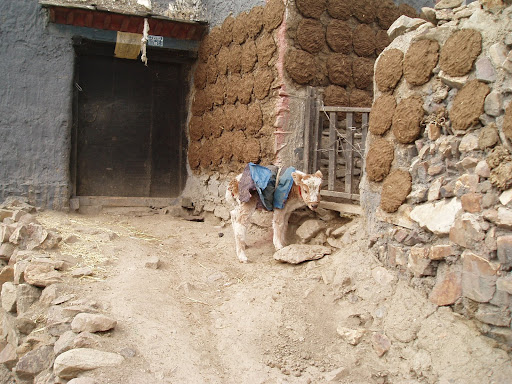
As I walked on I came across a run-down village which although seemed uninhabited threw signs of life at me in the form of calf tied at the front door, hens pecking at the ground. Just when I thought no one was around, I heard someone speak English. I caught site of two people trying to hid behind some rumbled walls. Then I realised that they were going for a pee. I decided to wait for them. I scared them off with my 'hello!' They weren't expecting me, of course. They were Jori and Aaron on their way to the stupas. We joined up. Within a few metres a couple of grime and dirt covered boys tried to show us the way across to what seemed another tiny village; a cluster of houses over a wooden bridge. We smiled and thanked them back. None of them spoke any English. We weren't sure were they tried to take us but it was surely where we wanted to get, that is, the stupas. The boys kept in our footsteps. We didn't mind them the least. They were friendly. The elder one, who was dressed in a black dusty jacket over a dirt-smeared shirts. Both boys wore rolled up trousers and their feet were showed through the holed and ragged shoes.
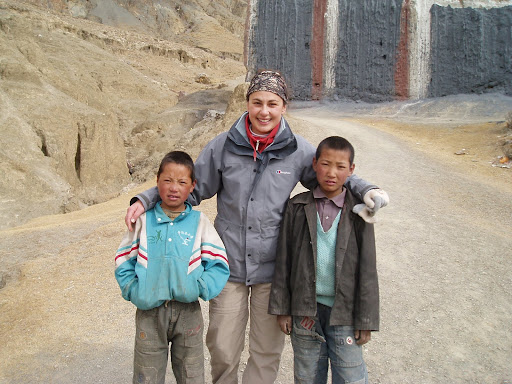
They took us to a tiny monastery and there at the door was an old monk. He invited us to come inside. We entered, very warily. The old monk didn't know any English either and spoke to us in Tibetan as he widely gestured towards an alter then a cave in which was a heavily decorated with a colourful deities surrounded by many orange ringed-flowers. The floor was covered with banknotes. We thought he wanted us to throw a small donation, so we did. We then took Aaron's water bottle, ducked under the rope-entrance and filled it with 'sacred water' - a stone basin with water which was sitting infront of the Buddha statue. Although Aaron thanked him deeply there was no way he was going to drink it, of course.
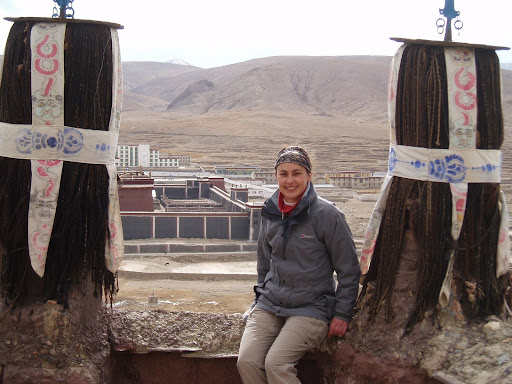
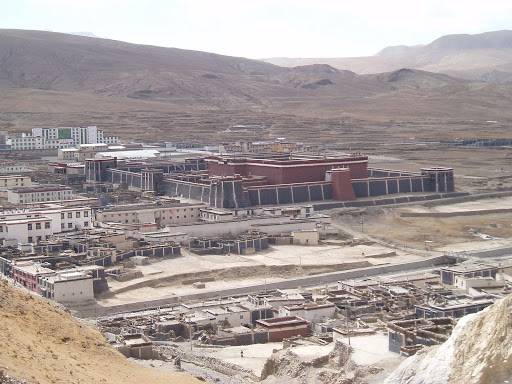
We left an proceeded towards the stupas. But the two little lads had other plans and guided us towards another Monastery. We actually climbed a wooden ladder onto the roof and from there had one of most spectacular view of the little town amongst it the rectangular-shaped Sakya Monastery. A monk quickly signalled us down with a you're-in-out-of-bounds-region look on his face.
Finally, we got to the stupas. Our young guides insisted that we'd walk round one of them we guessed it was a form of a blessing. So we circled round each one as if to symbolise our spiritual victory on reaching our mini pilgrimage destination. At one point, the older lad wrote '1808' in the sand with a twig. We couldn't decipher what that meant or implied. Later, our local guide told us that '1808' was the year the originals of those stupas were destroyed. They were rebuilt given Chinese approval in 1998.
On our way back we met the family on pilgrimage again and they asked us to follow them. The track was precarious, walking along a narrow roughly-cut track jutting out from the side of the hill. We finally made it back to the hotel, just in time to join the others to tour the huge Sakya Monastery. Unfortunately, the Monastery was rebuilt by Chinese thus it's blend architecture. The only rich feature being a marvellous sand mandala inside the Monastery. We also walked along the perimeter of the Monastery's roof overlooking the massive centre courtyard.
We had dinner at the same restaurant where we had lunch then tucked ourselves tight in bed trying to keep warm all night.
Next......Everest base camp ....and did I finally got to stay there overnight??!?!?
ta for now
Nicky
* taken from Wikipedia


